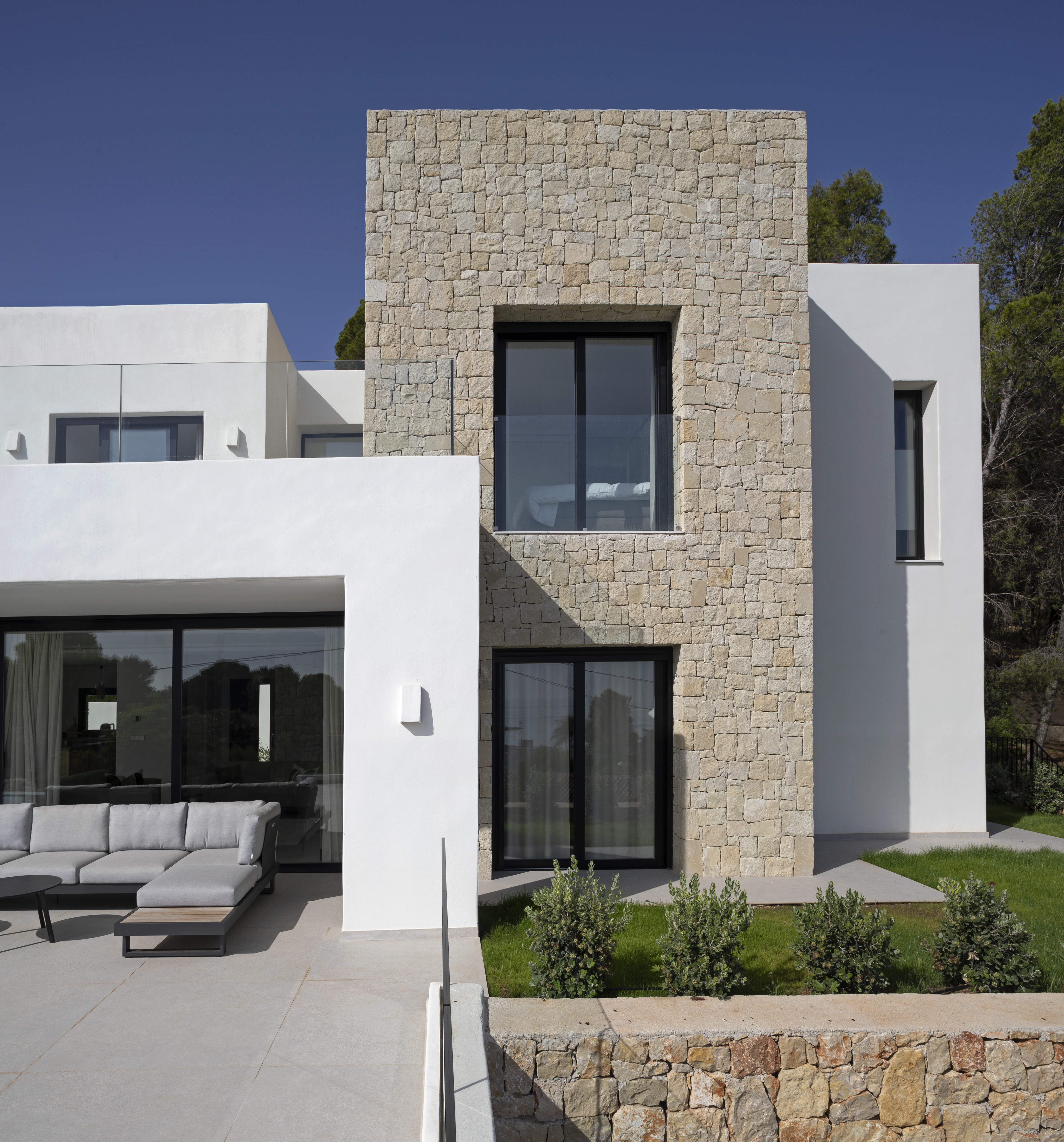
Contemporary Mediterranean architecture: how to design a home connected to its surroundings
Mediterranean architecture has always been deeply linked to the place where it is built. Light, climate, vegetation and proximity to the sea have conditioned the way homes are designed and inhabited for centuries.
Today, many of these traditional principles are still present, although reinterpreted from a more contemporary architecture.
In places like Dénia, Jávea or Moraira, designing a home connected to its surroundings does not simply mean resorting to white walls, natural stone or large terraces. It means understanding the characteristics of the landscape and taking advantage of them to achieve more pleasant, efficient spaces adapted to Mediterranean life.
Orientation as a starting point
A good home starts long before choosing the materials or defining its finishes.
The orientation conditions the entry of natural light, the interior temperature and the relationship of each room with the exterior. For this reason, the design should always start from a study of the plot, its solar path, the views and the particular conditions of the environment.
On the Costa Blanca, where we enjoy a high number of hours of sunshine throughout the year, controlling this exposure is especially important.
The objective is not to get as much light as possible, but to have the right light at every time of the day and year.
Light, shadow and spaces in between
One of the most characteristic elements of Mediterranean architecture is precisely shade.
Porches, pergolas, overhangs and covered terraces create intermediate spaces between the interior and exterior that allow you to enjoy the house for a good part of the year.
These elements also serve a climatic function.
Well sized, they can protect large glazed surfaces from direct sunlight during the warmer months and allow more light to enter during the winter.
Contemporary architecture thus recovers traditional solutions and integrates them into homes with much more open designs.
A different relationship between interior and exterior
In the Mediterranean, outdoor spaces should not be understood as a complement to housing.
They are part of it.
Terraces, patios, gardens, swimming pools and shaded areas expand the interior spaces and allow the house to be adapted to different times of the year.
Today's large openings and joinery systems make it possible to reduce the physical separation between the two environments.
When the project is well resolved, the living room, kitchen, terrace and garden can function as a single continuous space.
This relationship is especially important in homes located by the sea or in natural environments, where the landscape can become another part of the architecture.
Take advantage of natural ventilation
Traditional Mediterranean architecture also offers important lessons on how to achieve comfortable homes in a natural way.
One of them is cross ventilation.
Correctly positioning the openings allows natural air currents to be generated that help to renew the environment and improve comfort for a good part of the year.
Current technology allows these strategies to be complemented with much more efficient air conditioning and ventilation systems, but a good architectural design should first take advantage of the natural conditions of the environment.
The most efficient home is not necessarily the one that incorporates the most technology, but the one that needs to use it less.
Materials that age well
Stone, wood, ceramics, mineral mortars and other natural materials continue to have an important presence in contemporary Mediterranean architecture.
Not only for aesthetic reasons.
They are materials capable of providing texture, warmth, and a visual connection to the landscape, but they can also offer great durability when selected correctly.
In a home located near the sea, the choice of materials becomes even more important. Humidity, solar radiation and salinity force us to think not only about how a house will look when it is finished, but also about how it will evolve over the years.
Designing with the aging of materials in mind is also designing with the future in mind.
The landscape is also part of the project
A house does not end where its façade ends.
The vegetation, the outdoor routes, the walls, the terraces and the swimming pool are all part of the same composition.
Integrating species adapted to the Mediterranean climate makes it possible to create gardens that are more coherent with the environment and, at the same time, reduce water and maintenance needs.
Olive trees, carob trees, lavenders, rosemary or different native species can help architecture and landscape to be perceived as a single whole.
On plots with views of the sea, the Montgó or the landscape of the Marina Alta, the environment itself can also become one of the main elements of the project.
Tradition and technology are not opposing concepts
Talking about Mediterranean architecture does not mean giving up on innovation.
A contemporary home can combine architectural principles used for generations with current systems of aerothermal energy, photovoltaic energy, home automation, high-performance insulation or mechanical ventilation.
The key is that technology accompanies architecture and does not try to replace a bad design.
Orientation, sun protection, insulation, ventilation and efficiency should be conceived as parts of the same strategy.
An architecture designed for the place
Contemporary Mediterranean architecture should not be understood as a closed style or as a succession of decorative elements.
It is, above all, a way of responding to the environment.
Understanding light, protecting yourself from the sun when necessary, taking advantage of ventilation, connecting indoor spaces with the outdoors and selecting materials capable of living with the climate are decisions that directly influence the quality of a home.
On the Costa Blanca, where the landscape and climate are a fundamental part of our way of life, designing with these conditions in mind allows us to create more comfortable, efficient and timeless homes.
Because good architecture should not impose itself on the place where it is located, but learn to be part of it.


